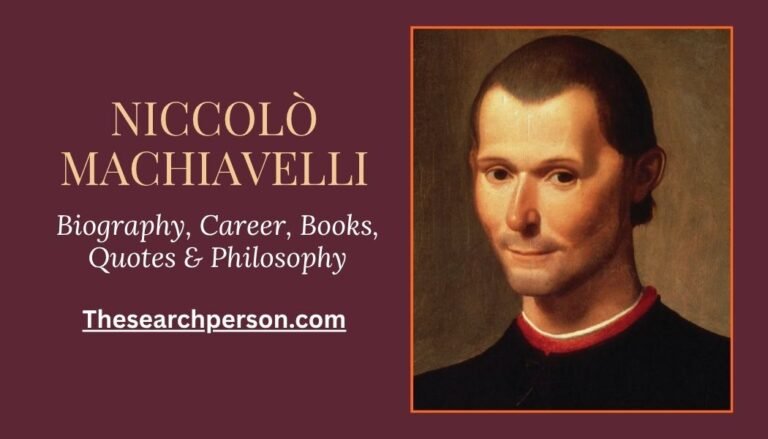
Who Was Niccolò Machiavelli?
Niccolò Machiavelli (1469–1527) was an Italian diplomat, philosopher, historian, and writer. He is most famous for his work in political theory, especially the book “The Prince”, which remains one of the most influential books on political power even today.
Machiavelli’s ideas gave rise to the term “Machiavellian”, which describes cunning, strategic, and sometimes ruthless political behavior.
Table of Contents
Niccolò Machiavelli Birthdate and Early Life
- Full Name: Niccolò di Bernardo dei Machiavelli
- Date of Birth: May 3, 1469
- Place of Birth: Florence, Republic of Florence (Italy)
- Parents: Bernardo di Niccolò Machiavelli and Bartolommea di Stefano Nelli
- Nationality: Italian
Machiavelli was born into a middle-class family in Florence. He received a humanist education, studying classics and Latin, which shaped his ideas about politics, history, and society.
Niccolò Machiavelli Education
Machiavelli was educated in Florence, where he learned Latin, classical literature, and history. He studied the works of Cicero, Livy, and Plato, which influenced his political thinking.
He also learned about diplomacy and governance by working with the government of Florence in his later years.
Niccolò Machiavelli Career
Machiavelli is most famous for his career as a diplomat and political theorist.
Key Roles
- Diplomat for the Republic of Florence – He traveled across Italy meeting rulers and studying politics.
- Military Official – Machiavelli was involved in organizing Florence’s militia.
- Writer & Historian – Authored books and essays on political theory, history, and strategy.
Political Context
Machiavelli lived during a time of political turmoil in Italy, with constant wars between city-states like Florence, Venice, and Rome. His experience in this environment gave him insights into power, leadership, and strategy.
Niccolò Machiavelli Books
Machiavelli wrote many books that continue to be studied today. Some of his most famous works include:
- The Prince (Il Principe) – A guide on how rulers should gain and maintain power.
- Discourses on Livy (Discorsi sopra la prima deca di Tito Livio) – A discussion on republican government.
- The Art of War (Dell’arte della guerra) – A book on military strategy.
- History of Florence (Istorie fiorentine) – Chronicles the history of his city.
- The Mandrake (La Mandragola) – A comedic play about human behavior.
These works cover politics, strategy, leadership, and human nature.
Niccolò Machiavelli Quotes
Machiavelli is known for his thought-provoking and sometimes controversial quotes. Here are some of the most famous:
- “The ends justify the means.”
- “It is better to be feared than loved, if you cannot be both.”
- “Men in general judge more from appearances than from reality.”
- “Politics have no relation to morals.”
- “The first method for estimating the intelligence of a ruler is to look at the men he has around him.”
These quotes reflect his realistic view of human nature and power.
Niccolò Machiavelli Philosophy
Machiavelli’s philosophy is centered on practical politics, not morality. He believed that a successful ruler must be pragmatic, strategic, and sometimes ruthless.
Core Principles
- Political Realism – Leaders must deal with reality, not ideals.
- Power and Stability – Maintaining power is more important than morality.
- Human Nature – People are often selfish, fickle, and driven by self-interest.
- Adaptability – Rulers must adapt to changing circumstances.
Machiavelli’s ideas are often misunderstood as purely ruthless, but he also valued stability, security, and public order.
Niccolò Machiavelli Death
- Date of Death: June 21, 1527
- Age at Death: 58 years
- Place of Death: Florence, Italy
Machiavelli died shortly after witnessing political chaos in Florence, leaving behind a legacy that would influence generations of politicians and thinkers.
Niccolò Machiavelli Family
- Father: Bernardo di Niccolò Machiavelli
- Mother: Bartolommea di Stefano Nelli
- Children: Totto Machiavelli and other descendants (details limited)
Machiavelli valued family and education, which reflected in his writings about leadership and responsibility.
What is Machiavelli Known For?
Machiavelli is most famous for:
- Writing “The Prince”, a guide to political leadership.
- Being a founder of modern political science.
- Developing the concept of Machiavellianism.
- Studying human nature and power dynamics realistically.
Machiavelli’s Theories
- The Ends Justify the Means – Achieving goals may require tough decisions.
- Virtù and Fortuna – Success depends on skill, courage, and luck.
- Political Stability – Power must be maintained to prevent chaos.
- Pragmatism over Morality – Leaders must prioritize results over ideals.
Frequently Asked Questions (FAQs)
1. Did Machiavelli believe in God?
Yes, Machiavelli believed in God but focused on practical politics rather than religious morality.
2. What was Machiavelli’s most famous quote?
“The ends justify the means” is widely attributed to him.
3. Who was Piero Machiavelli?
Piero was a relative of Niccolò Machiavelli, though not much is documented about him.
4. What was Machiavelli’s theory?
His main theory emphasized realistic politics, human nature, and the importance of power and strategy.
5. How do you pronounce Niccolò Machiavelli?
It is pronounced: Nee-ko-lo Ma-ki-a-vel-lee.
Legacy of Niccolò Machiavelli
Niccolò Machiavelli is considered the father of modern political science. His work has influenced:
- Politicians like Napoleon, Bismarck, and Roosevelt
- Modern political strategies and diplomacy
- Philosophy and leadership studies worldwide
Even today, students and leaders study his books to understand politics, strategy, and power dynamics.
Interesting Facts About Machiavelli
- He wrote both political treatises and comedies.
- “The Prince” was not widely published during his lifetime.
- He believed that fear is a more reliable motivator than love for rulers.
- Machiavelli worked under the Florentine Republic before being exiled.
- His name became synonymous with political cunning and strategy.