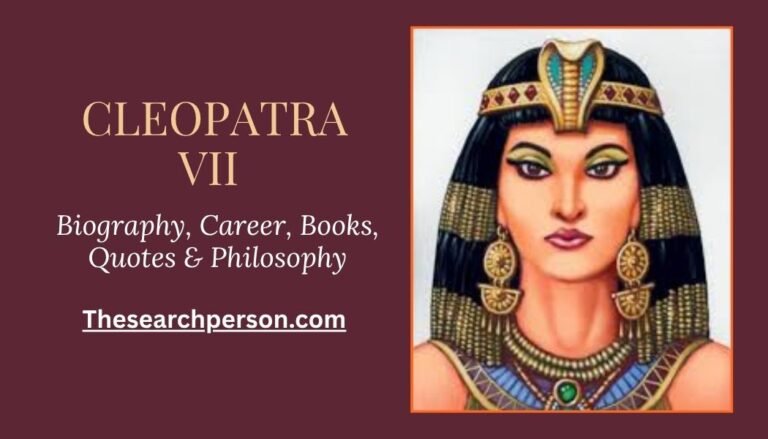
When we talk about the most fascinating women in world history, one name shines brighter than the rest – Cleopatra VII Philopator. She was not just a queen but a symbol of beauty, intelligence, and power. Cleopatra VII ruled ancient Egypt more than 2,000 years ago, but her story still inspires historians, writers, and filmmakers even today.
Who Was Cleopatra VII?
Cleopatra VII was the last active ruler of the Ptolemaic Kingdom of Egypt, born in 69 BC in Alexandria, Egypt. She came from the Ptolemaic dynasty, which descended from one of Alexander the Great’s generals. Her full name was Cleopatra VII Thea Philopator, which means “the goddess who loves her father.”
Many people wonder — “Is Cleopatra real?”
Yes, she was a real historical figure who ruled Egypt with unmatched charm and intellect. Unlike many queens who depended on others, Cleopatra was a powerful leader, strategist, and linguist who could speak multiple languages.
Table of Contents
Early Life and Education
Cleopatra was born into royalty, but her early life wasn’t easy. The Ptolemaic family was filled with rivalries and power struggles. Her father, Ptolemy XII Auletes, was the ruler of Egypt, and Cleopatra grew up watching political conflicts unfold around her.
What made Cleopatra unique was her education. She studied philosophy, mathematics, astronomy, and languages. While most of her ancestors spoke only Greek, Cleopatra learned to speak Egyptian fluently — becoming the first Ptolemaic ruler to do so. This helped her connect deeply with her people.
From a young age, she showed signs of intelligence, leadership, and a strong will to protect Egypt’s independence from Roman domination.
Cleopatra’s Rise to the Throne
Cleopatra became queen in 51 BC, at just 18 years old, ruling jointly with her younger brother Ptolemy XIII, who was about 10 years old. As per Egyptian custom, they were married — though it was only symbolic.
Soon after becoming co-rulers, a power struggle broke out between Cleopatra and her brother. Advisors to Ptolemy XIII tried to remove Cleopatra from power, and she was forced to flee Egypt. But Cleopatra was not one to give up easily.
Her comeback story began when she met Julius Caesar, one of Rome’s most powerful generals.
Cleopatra and Julius Caesar: A Powerful Alliance
In 48 BC, Cleopatra secretly entered Alexandria to meet Caesar. According to ancient accounts, she had herself smuggled into Caesar’s quarters wrapped in a carpet — one of the most famous moments in history.
Caesar was immediately impressed by Cleopatra’s intelligence and charisma. Together, they formed a strong political and romantic alliance. With Caesar’s support, Cleopatra regained her throne and became the sole ruler of Egypt.
She later gave birth to a son named Caesarion (Ptolemy XV), whom she claimed was Caesar’s child. Cleopatra visited Rome and lived there for some time, enjoying Caesar’s protection and influence. However, after Caesar was assassinated in 44 BC, Cleopatra returned to Egypt, facing new political challenges.
Cleopatra and Mark Antony: Love and Politics
After Caesar’s death, Rome fell into civil war. Two main leaders emerged — Octavian (later Augustus) and Mark Antony. Cleopatra aligned herself with Mark Antony, another powerful Roman general.
Their meeting in 41 BC was legendary. Cleopatra arrived on a golden ship decorated with purple sails, dressed as the goddess Aphrodite. Antony was immediately captivated by her beauty and wit. Soon, their relationship turned into one of the most famous love stories in history.
Cleopatra and Antony had three children together — Alexander Helios, Cleopatra Selene, and Ptolemy Philadelphus. Together, they tried to create a powerful Eastern empire, which threatened Octavian’s ambitions in Rome.
The Fall of Cleopatra and Mark Antony
Octavian used propaganda to turn Rome against Antony and Cleopatra. He portrayed Cleopatra as a foreign seductress who had bewitched a Roman general. In 31 BC, Octavian’s forces defeated Antony and Cleopatra in the Battle of Actium.
After their defeat, both Antony and Cleopatra fled to Alexandria. Facing capture, Mark Antony took his own life. Soon after, Cleopatra followed him.
How Did Cleopatra Die?
One of the biggest mysteries in history is how Cleopatra died. Ancient writers say she committed suicide by allowing an asp (a venomous snake) to bite her. However, some modern historians believe she might have used poison instead.
Cleopatra died in 30 BC at the age of 39. With her death, Egypt fell under Roman control, marking the end of the Ptolemaic dynasty and the beginning of Roman Egypt.
Her death was not just the end of a queen but the end of an entire era of Egyptian independence.
What Did the Real Cleopatra Look Like?
Many people wonder about Cleopatra’s real face. Hollywood often shows her as a breathtaking beauty, but historical evidence suggests something different. Ancient coins and sculptures show Cleopatra with a strong nose, sharp chin, and confident expression.
She may not have been classically beautiful, but her intelligence, charm, and confidence made her incredibly attractive. Roman historian Plutarch once wrote, “Her beauty was not in itself incomparable, but the charm of her presence was irresistible.”
In short, Cleopatra’s true power came not from her looks but from her personality, intelligence, and leadership.
Career and Achievements
Cleopatra wasn’t just a queen by title — she was a true leader who worked hard to strengthen Egypt’s economy, culture, and global position.
1. Political Skills
Cleopatra was an expert diplomat. She managed to balance Egypt’s interests with the power of Rome for many years through smart alliances and relationships.
2. Economic Reforms
She improved trade, stabilized Egypt’s currency, and promoted agriculture. Under her rule, Egypt remained one of the richest nations in the Mediterranean world.
3. Patron of Arts and Science
Cleopatra supported learning and the arts. Alexandria, her capital, was home to the Library of Alexandria, one of the greatest centers of knowledge in history.
4. Role in Roman Politics
Cleopatra played a major part in shaping Roman politics. Her relationships with Caesar and Antony changed the course of Roman history.
Famous Cleopatra Quotes
Here are some famous quotes inspired by or attributed to Cleopatra that reflect her wisdom and strength:
- “I will not be triumphed over.”
- “All strange and terrible events are welcome, but comforts we despise.”
- “Fool! Don’t you see now that I could have poisoned you a hundred times had I been able to live without you?”
- “In praising Antony, I have dispraised Caesar.”
These quotes show her pride, intelligence, and emotional depth. She was a woman who valued dignity above everything.
Books and Literature
Cleopatra’s story has inspired countless writers over the centuries. Here are a few famous books and plays about her:
- “Antony and Cleopatra” by William Shakespeare – A timeless play about love, power, and tragedy.
- “Cleopatra: A Life” by Stacy Schiff – A modern biography that gives a deep and realistic view of Cleopatra’s life.
- “Caesar and Cleopatra” by George Bernard Shaw – A play that explores her early years and relationship with Julius Caesar.
- “The Memoirs of Cleopatra” by Margaret George – A detailed historical novel told from Cleopatra’s perspective.
Each of these books shows a different side of her — as a lover, a ruler, and a legend.
Cleopatra in Movies and Pop Culture
Cleopatra’s story has been told in films, TV shows, and documentaries for decades. The most famous portrayal is Elizabeth Taylor’s 1963 film “Cleopatra”, one of the most expensive movies ever made.
Other actresses like Sophia Loren, Monica Bellucci, and Gal Gadot have also been linked to Cleopatra roles, keeping her legacy alive for new generations.
These films show her as a woman who was not just beautiful but also brave, intelligent, and politically smart.
Cleopatra’s Philosophy and Legacy
Cleopatra’s philosophy was simple yet powerful — knowledge is power. She believed in using intelligence, not just beauty, to achieve her goals. Her rule was guided by ideas of self-reliance, diplomacy, and leadership.
Even though she lived more than two millennia ago, Cleopatra remains a symbol of female empowerment. She showed that women could rule, lead, and influence global politics with grace and strategy.
Interesting Facts About Cleopatra VII
Here are some lesser-known but fascinating facts:
- Cleopatra could speak around 9 languages.
- She was the last pharaoh of Egypt.
- She was not Egyptian by blood, but Greek (from the Macedonian Ptolemaic dynasty).
- Cleopatra was the first of her dynasty to embrace Egyptian culture.
- Her death marked the end of Ancient Egypt as an independent kingdom.
Cleopatra’s Net Worth and Wealth
Cleopatra ruled one of the wealthiest empires of her time. Historians estimate that her personal fortune would equal billions of dollars today. Egypt’s control over trade routes and natural resources made her one of the richest women in history.
Her luxury and royal lifestyle — from golden ships to lavish palaces — are still the stuff of legend.
Cleopatra’s Impact on Women and Modern Society
Cleopatra has become an icon for powerful women. She inspires leaders, artists, and feminists across the world. Her life teaches us that:
- Intelligence can be more powerful than beauty.
- Women can lead nations and influence history.
- Confidence and courage can outlast time.
Even after 2,000 years, Cleopatra remains a symbol of leadership, intelligence, and resilience.
Conclusion: The Immortal Queen
Cleopatra VII’s story is not just about love and tragedy — it’s about power, intelligence, and legacy. She was a ruler who fought for her country, a woman who shaped world politics, and a figure who refused to be forgotten.