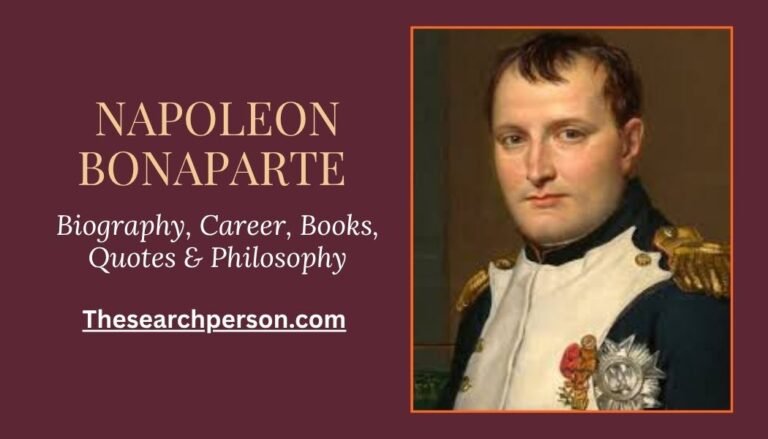
Napoleon Bonaparte — the name that echoes power, strategy, and ambition — is one of the most influential figures in world history. From his early life in Corsica to becoming Emperor of France, Napoleon’s journey is filled with wars, politics, and philosophy.
Who Was Napoleon Bonaparte?
Napoleon Bonaparte was a French military leader and emperor who rose to prominence during the French Revolution. He ruled France from 1804 to 1814 and again in 1815 during the Hundred Days before his final defeat at Waterloo.
Napoleon is best known for his military genius, his ambitious reforms in France, and his efforts to build a vast European empire.
Full Name: Napoléon Bonaparte
Born: August 15, 1769
Birthplace: Ajaccio, Corsica
Died: May 5, 1821
Occupation: Military General, Emperor of France
Nationality: French
Table of Contents
Early Life and Birthplace
Napoleon was born on August 15, 1769, in Ajaccio, Corsica, just a year after the island became part of France. His parents, Carlo Buonaparte and Letizia Ramolino, belonged to a minor noble family of Italian origin.
Even as a child, Napoleon showed leadership qualities and an intense curiosity about history, mathematics, and military tactics.
Family Background and Education
Napoleon’s father, Carlo, was a lawyer and representative of Corsica to the French king, while his mother, Letizia, was known for her strong discipline. Napoleon had seven siblings, and many of them later held significant political positions during his reign.
He was sent to France at age 9 to study at a military academy. Later, he attended the École Militaire in Paris, where he specialized in artillery — a skill that would become key to his success.
Napoleon Bonaparte Height and Appearance
Napoleon’s height has been a topic of debate for centuries.
| Feature | Details |
|---|---|
| Height | 5 feet 6 inches (1.68 m) |
| Eye Color | Blue-Grey |
| Hair Color | Brown |
| Build | Medium, sturdy physique |
Despite the myth of being “short,” Napoleon’s height was average for French men of his era. The confusion arose due to differences between French and British measurement units.
Military Career and Rise to Power
Napoleon’s career began when he joined the French Army as a second lieutenant in artillery. His strategic brilliance first shone during the Siege of Toulon (1793).
He gained massive recognition after his victories in Italy (1796-97) and Egypt (1798), where his leadership and courage stood out.
Key Milestones in His Career:
| Year | Event |
|---|---|
| 1793 | Siege of Toulon – First major success |
| 1799 | Coup d’état – Overthrew the French Directory |
| 1804 | Crowned himself Emperor of France |
| 1805 | Won Battle of Austerlitz – his greatest victory |
| 1812 | Invasion of Russia – beginning of decline |
| 1815 | Final defeat at Battle of Waterloo |
His military strategies are still studied in academies around the world. Napoleon mastered the art of dividing and conquering through rapid movements and surprise attacks.
Napoleon’s Reforms and Achievements
Apart from being a warrior, Napoleon was also a reformer who reshaped modern France.
Major Achievements:
- Napoleonic Code (1804): A civil law system that influenced countries worldwide.
- Education Reform: Established state-run schools (lycées).
- Economic Reform: Created the Bank of France to stabilize the economy.
- Religious Policy: Signed the Concordat of 1801 with the Pope, balancing religion and state.
- Infrastructure: Improved roads, bridges, and public services.
His policies helped modernize France and laid the foundation for many European legal systems.
Napoleon’s Love Life and Wife
Napoleon was deeply romantic, and his personal life attracted as much attention as his military campaigns.
His Wives:
- Joséphine de Beauharnais (married 1796–1810) – His first love, though they later divorced due to her inability to bear children.
- Marie Louise of Austria (married 1810–1821) – She bore him a son, Napoleon II, often called the “King of Rome.”
Despite his ambitious political life, Napoleon remained affectionate and emotional in private letters, revealing his human side.
Napoleon’s Books and Writings
Napoleon was not just a warrior; he was also a thinker and writer.
Famous Books and Works by or about Napoleon:
| Title | Type |
|---|---|
| Clisson et Eugénie | Romantic novella written by Napoleon himself |
| The Napoleon Papers | Letters and dispatches during campaigns |
| Napoleon’s Maxims of War | Collection of his military principles |
| Napoleon on Napoleon | Autobiographical writings during exile |
He also read extensively — from Roman history to philosophy — and admired great thinkers like Julius Caesar and Rousseau.
Napoleon Bonaparte’s Quotes and Philosophy
Napoleon’s words continue to inspire leaders and thinkers across the world.
Most Famous Napoleon Quotes:
- “Impossible is a word to be found only in the dictionary of fools.”
- “A leader is a dealer in hope.”
- “If you want a thing done well, do it yourself.”
- “History is the version of past events that people have decided to agree upon.”
Philosophy:
Napoleon believed in merit over birth, discipline, and strategic thinking. His leadership style emphasized confidence, loyalty, and swift action.
He often said that a man’s destiny could be shaped by willpower — a reflection of his philosophical mindset.
Napoleon’s Downfall and Death
After his disastrous invasion of Russia (1812), Napoleon’s power began to decline. His enemies formed coalitions, and by 1814, he was forced to abdicate and exiled to Elba.
He briefly returned to power in 1815 (The Hundred Days) but was defeated at the Battle of Waterloo by British and Prussian forces.
He was exiled again — this time to Saint Helena, a remote island in the South Atlantic, where he died on May 5, 1821, at the age of 51.
The official cause of death was stomach cancer, though some theories suggest arsenic poisoning.
Napoleon Bonaparte in Movies
Napoleon’s life has been a favorite topic for filmmakers.
Famous Napoleon Movies:
| Movie Title | Year | Actor |
|---|---|---|
| Napoléon | 1927 | Albert Dieudonné |
| Waterloo | 1970 | Rod Steiger |
| Napoleon and Josephine: A Love Story | 1987 | Armand Assante |
| Napoleon | 2023 | Joaquin Phoenix |
The upcoming Ridley Scott movie “Napoleon” (2023) starring Joaquin Phoenix revived interest in his story for modern audiences.
Napoleon Bonaparte’s Legacy
Napoleon’s influence extends beyond France. His Napoleonic Code became the foundation for modern legal systems. His reforms in education, infrastructure, and governance inspired countries worldwide.
Even centuries later, his name symbolizes power, intelligence, and ambition.
Frequently Asked Questions
1. What was Napoleon Bonaparte’s height?
He was about 5 feet 6 inches (1.68 meters) tall — average for his time.
2. What was Napoleon’s cause of death?
He died from stomach cancer on May 5, 1821, in Saint Helena.
3. Who was Napoleon’s wife?
He had two wives — Joséphine de Beauharnais and Marie Louise of Austria.
4. What is Napoleon Bonaparte famous for?
He’s known for being Emperor of France, a brilliant military strategist, and the creator of the Napoleonic Code.
5. Did Napoleon write any books?
Yes, he wrote Clisson et Eugénie and many military writings and letters.
Conclusion
Napoleon Bonaparte remains a legend — a man who reshaped Europe through his vision and power. His life story continues to teach lessons on leadership, courage, and ambition.
More Info About TheSearchPerson