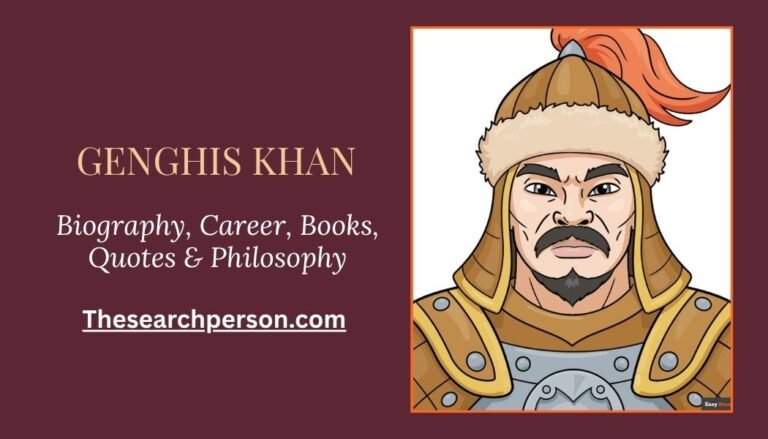
Genghis Khan is one of the most powerful and talked-about leaders in world history. His name is linked with courage, strategy, power, and unity. Many people know him as a great warrior, but there is much more to his story. His life is full of lessons about leadership, discipline, and how one person can change the world.
Who Was Genghis Khan?
Genghis Khan was the founder of the Mongol Empire, which became the largest land empire in the world. His birth name was Temujin, and he later took the title “Genghis Khan,” meaning “Universal Leader.”
Even though he came from a poor background and faced many struggles as a child, he later became one of the most powerful rulers in history.
Table of Contents
Early Life of Genghis Khan
Genghis Khan was born in 1162 in Mongolia. His real name was Temujin. He belonged to a tribe called the Borjigin clan.
Childhood Struggle
Temujin’s childhood was not easy. His father, Yesugei, was poisoned by enemies when Temujin was very young. After that, his family lost all support and lived in poverty.
Temujin had to hunt, work hard for food, and protect his family. These struggles made him strong and taught him the importance of unity.
Growing Up as a Leader
Even as a boy, Temujin showed leadership. He built strong bonds with friends and other tribe members. His courage and smart thinking helped him rise from a simple boy to a respected warrior.
How Temujin Became Genghis Khan
At the age of 20, Temujin started gathering loyal followers. He fought many battles to unite the different Mongol tribes.
In 1206, after winning important battles and bringing many tribes together, Temujin was given the title Genghis Khan, meaning:
Universal Ruler
Leader of All Mongols
This was the beginning of the Mongol Empire.
Career and Rise of the Mongol Empire
Genghis Khan’s career as a leader is full of victories and strong decisions. He built a powerful army that became unstoppable.
Military Skills
Genghis Khan used smart strategies:
- Fast-moving horsemen
- Surprise attacks
- Strong discipline
- Clear communication
His army was famous for moving quickly and attacking at the right moment.
Major Conquests
Genghis Khan conquered many regions:
- Northern China
- Central Asia
- Persia
- Eastern Europe
Under his leadership, the Mongol Empire grew larger than the Roman Empire, Ottoman Empire, and all earlier kingdoms.
SEO Keywords Covered:
genghis khan empire, genghis khan career, genghis khan history
Genghis Khan’s Leadership Style
Genghis Khan was not only a warrior. He was also a smart manager and planner.
Talent over family
He promoted people based on skills, not family background.
Freedom of Religion
He allowed people in his empire to follow any religion. This made his rule more peaceful.
Strong Laws
He created a law system called Yassa, which included rules for fairness, loyalty, and punishment for crimes.
Books on Genghis Khan
Many authors have written books about Genghis Khan’s life. Some famous ones include:
Genghis Khan and the Making of the Modern World
By Jack Weatherford
Genghis Khan: His Conquests, His Empire, His Legacy
By Frank McLynn
The Secret History of the Mongol Queens
By Jack Weatherford
These books help us understand his strategies, personal life, and empire building.
SEO Keywords: genghis khan book, genghis khan biography book
Genghis Khan Pronunciation
Many people pronounce his name differently. The correct pronunciation is:
“Ching-gis Khan”
(With a soft “Ch”)
In English-speaking countries, people often say “Gen-jis Khan,” but the original Mongolian sound is “Ching-gis.”
SEO Keyword: genghis khan pronunciation
Genghis Khan Family and Children
Genghis Khan had many children. He had wives and partners from different regions, which was common for Mongol rulers at that time.
Most Known Children
His four main sons from his first wife Börte:
- Jochi
- Chagatai
- Ögedei
- Tolui
After his death, parts of the empire were divided among them.
SEO Keyword: genghis khan children
Genghis Khan Descendants
One interesting fact is that many people today share DNA linked to Genghis Khan. Some studies suggest that about 16 million men may be his descendants.
This is because he had many children and his sons continued the family line across different regions.
SEO Keyword: genghis khan descendants
Genghis Khan Cause of Death
Genghis Khan died in 1227. There are several theories about his death:
Possible reasons:
- He fell from a horse
- He got sick
- He was injured in battle
The exact cause is still unknown because Mongols kept it secret.
SEO Keyword: genghis khan cause of death
Genghis Khan Religion
Genghis Khan followed Tengrism.
What is Tengrism?
It is an ancient religion in Central Asia that believes in:
- Eternal blue sky
- Nature spirits
- Ancestors
He also respected other religions like Buddhism, Islam, and Christianity.
SEO Keyword: genghis khan religion
Genghis Khan Net Worth
Genghis Khan did not have personal wealth like today’s billionaires. But if we compare his power in today’s terms:
He controlled almost 12 million square miles of land.
This would make him richer than any modern billionaire.
So, in modern value, he would be worth hundreds of trillions.
SEO Keyword: genghis khan net worth
The Legacy of Genghis Khan
Genghis Khan changed the world in many ways:
Connected Asia and Europe
He created trade routes that later became the Silk Road.
Promoted communication
He built a postal system for fast messages.
Cultural exchange
Different ideas, goods, and languages travelled across his empire.
His empire lasted for many years, even after his death.
Genghis Khan Philosophy
Genghis Khan believed in:
Unity
He always said that strength comes from staying together.
Hard Work
He worked hard all his life, from childhood to leadership.
Fairness
He gave rewards to loyal people and followed strict laws.
Courage
He faced many dangers but never gave up.
His philosophy shows how discipline and belief can change life.
Famous Genghis Khan Quotes
Here are some of his well-known quotes:
“I am the punishment of God. If you had not committed great sins, God would not have sent a punishment like me upon you.”
“A man’s greatest joy is in defeating his enemies.”
“The strength of a wall is neither greater nor less than the courage of the men who defend it.”
“If you are afraid, don’t do it. If you do it, don’t be afraid.”
These quotes show his mindset and leadership style.
Timeline of Genghis Khan
Here is a simple timeline:
| Year | Event |
|---|---|
| 1162 | Born as Temujin |
| 1171 | Father dies |
| 1189 | Becomes a tribal leader |
| 1206 | Declared Genghis Khan |
| 1210–1227 | Major conquests |
| 1227 | Dies |
Genghis Khan Empire Map Overview
The Mongol Empire spread across:
- China
- Russia
- Middle East
- Central Asia
- Parts of Europe
It was the largest empire in history by land area.
Modern-Day Influence of Genghis Khan
Even today, his name is known all over the world. People study his leadership in:
- Military schools
- Management studies
- History books
He is often seen as one of the most influential leaders in history.
FAQs About Genghis Khan
1. What is Genghis Khan’s real name?
His real name was Temujin.
2. How do you pronounce Genghis Khan?
Correct pronunciation: Ching-gis Khan.
3. What religion did he follow?
He followed Tengrism.
4. How did Genghis Khan die?
The exact cause is unknown, but many believe he died due to injury or illness.
5. Did Genghis Khan have children?
Yes, he had many children. Four main sons from his wife Börte became important leaders.
6. How big was Genghis Khan’s empire?
It was the largest land empire in world history.
7. How rich would Genghis Khan be today?
He would be worth hundreds of trillions, more than any modern billionaire.
More Info About TheSearchPerson