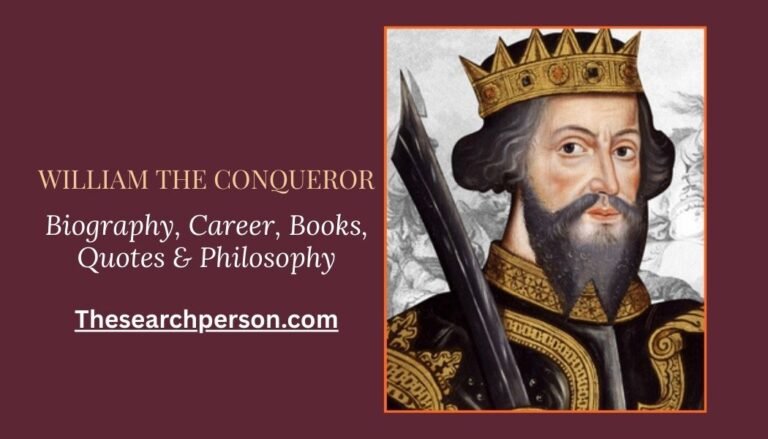
William the Conqueror (1028–1087) stands as one of the most influential rulers in world history. Known first as William I of England and earlier as William the Bastard, he transformed medieval Europe through military conquest, political reform, and institutional restructuring that shaped modern England.
His 1066 victory at the Battle of Hastings changed not only England’s ruling dynasty but also its culture, land system, language, and governance. William’s story is one of determination, resilience, and vision — qualities that established him as a legendary medieval leader.
Quick Info
| Attributes | Details |
|---|---|
| Full Name | William I of England |
| Birth | 1028, Falaise, Normandy |
| Death | 1087, Rouen |
| Titles | Duke of Normandy, King of England |
| Known For | Norman Conquest of 1066 |
Table of Contents
Early Life & Background
William was born in Falaise, Normandy, as the illegitimate son of Duke Robert I. His mother, Herleva (a tanner’s daughter), put William at a political disadvantage early on. Yet this hardship shaped his character — he grew resilient, strategic, and unyielding.
Orphaned young, he survived assassination attempts, political unrest, and rebellion. But every challenge strengthened him. By his late teens, William had already proven himself capable of leading armies and suppressing revolts.
In 1035, after the death of his father, William inherited the Duchy of Normandy, beginning his journey toward becoming one of the most formidable rulers in European history.
Physical Stats & Personal Traits
| Attribute | Details |
|---|---|
| Height | Estimated 5’10’’–6’0’’ (tall for medieval standards) |
| Build | Robust, broad-shouldered, powerful frame |
| Appearance | Red-haired in youth; commanding presence |
| Personality Traits | Determined, strategic, stern, disciplined |
| Leadership Style | Authoritative, militaristic, pragmatic |
| Known Strengths | War tactics, administration, endurance |
| Weaknesses | Harsh punishments, strict rule, limited mercy |
Historical accounts depict William as physically imposing and mentally relentless — a warrior-king built for conquest.
Career Timeline — From Duke to King
William’s career unfolded in distinct stages, each marked by battles, reforms, and bold decisions.
Career Timeline
| Phase | Age | Position | Key Events |
|---|---|---|---|
| Childhood | 0–8 | Heir to Normandy | Survives political instability |
| Adolescence | 8–15 | Young Duke | Faces rebellions, forms alliances |
| Early Adulthood | 15–30 | Duke of Normandy | Strengthens military control |
| Mid-Life | 30–38 | Claimant to English throne | Conflict with Harold Godwinson |
| 1066 | 38 | Conqueror | Wins Battle of Hastings |
| 1066–1087 | 38–59 | King of England | Reform, taxation, castle-building |
Key Military Campaigns
1. Battle of Val-ès-Dunes (1047)
William defeated rebellious Norman barons, strengthening his control.
2. The Norman Invasion (1066)
The event that changed the world. William crossed the English Channel to claim the throne promised to him.
- Harold Godwinson was defeated
- Normans established dominance
- William crowned on Christmas Day 1066
3. The Harrying of the North (1069–1070)
A brutal yet strategic suppression of rebellion, cementing William’s rule in northern England.
Administrative Reforms
William was not only a conqueror but also a system-builder.
The Feudal System
He redistributed land to loyal Norman lords, weakening old Anglo-Saxon elites.
The Domesday Book (1086)
A groundbreaking census and economic survey — still one of Europe’s most valuable historical documents.
Castle-Building Program
Over 500 motte-and-bailey castles built, including the Tower of London, to enforce authority.
Books, Writings & Historical Texts About Him
While William didn’t write books in the modern sense, numerous medieval and modern works depict his life.
Books & Texts Table
| Category | Titles / Works |
|---|---|
| Medieval Chronicles | Anglo-Saxon Chronicle, Gesta Guillelmi, Carmen de Hastingae Proelio |
| Modern Biographies | William the Conqueror by David Bates, The Norman Conquest by Marc Morris |
| Literary Mentions | Many English historical novels depict him |
| Academic Studies | Works on feudalism, medieval warfare, and Norman politics |
Famous Quotes & Interpretations
Though direct quotes from William are limited, the ones attributed to him reflect a strong and authoritative mind.
Popular Attributed Quotes
- “I attacked the English like a ravenous lion.”
Symbolizes his warlike nature. - “Do not trust the loyalty of men who betrayed their own lord.”
Reflects his realist political thinking. - “I acquired this land by force, and force keeps it.”
His direct understanding of medieval power.
William the Conqueror’s Philosophy & Leadership Principles
William’s philosophy can be understood through his decisions:
Philosophy Breakdown Table
| Theme | Description |
|---|---|
| Power | Authority must be enforced through strength |
| Loyalty | Demanded absolute loyalty; rewarded accordingly |
| Justice | Harsh but consistent; maintained order |
| Governance | Strategic land redistribution created long-term stability |
| Warfare | Calculated aggression; psychological dominance |
| Legacy | Focused on durable institutions, not just victory |
He believed order comes from control, and control comes from strategy, not just violence.
Family, Marriage & Relationships
William married Matilda of Flanders, forming a politically strategic union.
Family Table
| Member | Description |
|---|---|
| Wife | Matilda of Flanders |
| Children | 9–10 including Robert Curthose, William II (Rufus), Henry I |
| Parents | Robert I of Normandy & Herleva |
| Relationship Style | Loyal, strict father; politically driven marriage |
Their marriage was strong — Matilda was influential, educated, and respected.
Wealth, Power & Economic Influence
William’s actual net worth cannot be calculated, but historians estimate his land and wealth made him:
One of the richest men in medieval European history
If converted to modern terms, his wealth would be equivalent to hundreds of billions of dollars, due to:
- Complete control of English land
- Taxation power
- Military dominance
- Ownership of castles and estates
Frequently Asked Questions (FAQ)
1. Why is William called “the Conqueror”?
Because he conquered England in 1066 and established Norman rule.
2. Was William of noble birth?
Yes, but illegitimate — which shaped his early challenges.
3. What is William the Conqueror most famous for?
Winning the Battle of Hastings and introducing Norman rule in England.
4. Did William write any books?
No, but many chronicles describe him in detail.
5. How did William die?
He died from injuries after falling off a horse in 1087.
6. What was William’s leadership style?
Strong, authoritative, and strategically calculated.
Conclusion
William the Conqueror’s life is a masterclass in leadership, resilience, and strategic brilliance. His victory in 1066 reshaped not just England but the entire trajectory of Western civilization. Through reforms, castles, feudal structures, and administrative systems, his legacy endures nearly 1,000 years later.
More Info About TheSearchPerson