
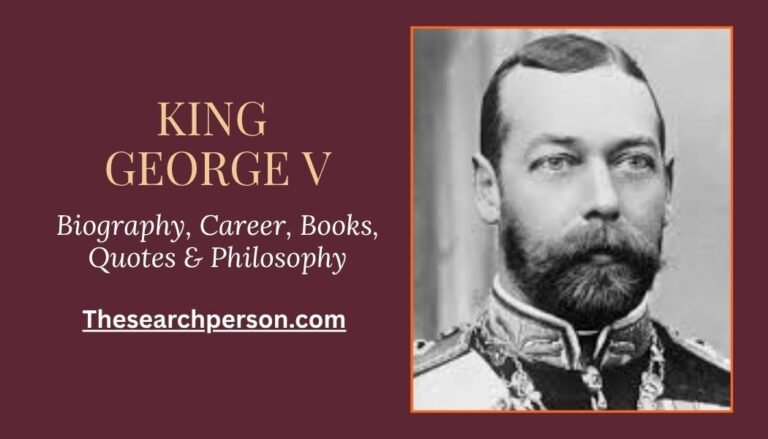
Great monarchs who shaped modern British history, King George V stands tall. He ruled during one of the most turbulent times in world history — through World War I, political reforms, and the early 20th-century transformation of the British Empire.
Quick Overview of King George V
| Full Name | George Frederick Ernest Albert |
|---|---|
| Popular Name | King George V |
| Born | June 3, 1865 |
| Birthplace | Marlborough House, London, England |
| Parents | King Edward VII (father) and Queen Alexandra (mother) |
| Wife | Queen Mary (Mary of Teck) |
| Children | Edward VIII, George VI, Mary, Henry, George, John |
| Reign | May 6 1910 – January 20 1936 |
| Predecessor | King Edward VII |
| Successor | King Edward VIII |
| Died | January 20 1936, at Sandringham House |
| Cause of Death | Lung disease and bronchial infection |
| Famous For | Leading Britain through WW I and modernizing the monarchy |
Table of Contents
Early Life and Family Background
King George V was born on June 3, 1865, at Marlborough House in London. He was the second son of Prince Albert Edward (later King Edward VII) and Princess Alexandra of Denmark.
Being the grandson of Queen Victoria, George grew up surrounded by royal duties and traditions. His childhood was strict but disciplined, as was common for royal families of that era.
George V’s Siblings
He had several siblings, including:
- Prince Albert Victor, Duke of Clarence
- Princess Louise
- Princess Victoria
- Princess Maud of Wales
After the death of his elder brother Albert Victor, George became the heir to the throne — a turning point that changed the direction of his life.
Early Career – Life in the Royal Navy
Before becoming king, George served in the Royal Navy.
At age 12, he joined the navy as a cadet and served on ships such as HMS Bacchante and HMS Alexandra.
He traveled the world — from the Caribbean to the Mediterranean and Asia — which gave him a global perspective and respect for duty.
His naval discipline shaped his personality. Many historians say that George’s calmness and leadership during WW I came from his early naval experience.
Marriage and Family Life
In 1893, George V married Princess Mary of Teck, who later became Queen Mary.
Their marriage was not just royal duty — it was a strong and loving partnership that lasted their entire lives.
They had six children:
- Edward VIII (later Duke of Windsor)
- George VI (father of Queen Elizabeth II)
- Princess Mary
- Prince Henry
- Prince George
- Prince John
Despite royal formality, George was a caring father and husband, although strict about discipline — reflecting his naval background.
Becoming King George V
George became king on May 6, 1910, following the death of his father King Edward VII.
His coronation took place on June 22, 1911, in Westminster Abbey, London.
His reign began during a period of major political and social change, including rising democracy, labor movements, and tensions within the British Empire.
King George V and World War I
When World War I broke out in 1914, King George V became a symbol of unity for Britain and its Empire.
He regularly visited soldiers, hospitals, and factories, boosting morale among troops and citizens.
However, there was one challenge — the British royal family had German ancestry. To avoid anti-German sentiment, George V changed the royal family name from “House of Saxe-Coburg and Gotha” to “House of Windsor” in 1917.
This decision was historic and helped the monarchy connect more closely with the British people.
Major Achievements and Reforms
King George V’s reign saw several key reforms and transformations:
- Formation of the Commonwealth:
After WW I, George promoted the idea of the British Commonwealth of Nations, allowing colonies more independence while maintaining unity. - Expansion of Democracy:
He oversaw the Parliament Act 1911, reducing the power of the House of Lords, and supported broader voting rights. - Social Welfare Support:
George V encouraged better working conditions and housing reforms for ordinary citizens. - Symbol of Stability:
During the Great Depression (1930s), he provided comfort and leadership to a struggling nation.
Books and Writings Related to King George V
Although King George V was not an author himself, several books document his reign and personal life.
| Book Title | Author | Published Year |
|---|---|---|
| King George V: A Personal Memoir | Harold Nicolson | 1952 |
| George V | Kenneth Rose | 1983 |
| King George V and the British Empire | David Cannadine | 2014 |
| King George V: The Man Who Saved the Monarchy | Jane Ridley | 2021 |
These books describe his sense of duty, simplicity, and devotion to his people.
Famous Quotes by King George V
King George V was known for his short, impactful sayings that revealed his straightforward nature.
“My father was frightened of his mother, I was frightened of my father, and I am damned well going to see to it that my children are frightened of me.”
“Teach my sons to be good men, not just kings.”
“I cannot understand modern life, but I shall do my duty to the end.”
These quotes show that George V valued discipline, family duty, and moral strength over luxury or power.
Did King George V Visit India?
Yes, he did.
King George V visited India in 1911 for the Delhi Durbar, a grand ceremony held to celebrate his coronation.
He was the only British monarch ever to visit India during his reign as Emperor of India.
He and Queen Mary were crowned Emperor and Empress of India at this historic event in Delhi.
This visit was a symbol of unity within the vast British Empire at that time.
What Was the Cause of Death of King George V?
King George V died on January 20, 1936, at Sandringham House in Norfolk, England.
The official cause of death was bronchial inflammation and lung disease, worsened by years of heavy smoking.
Reports later suggested that his physician administered morphine and cocaine to speed up his passing — a controversial topic even today.
What Were King George V’s Last Words?
According to royal historians, his last words were:
“How is the Empire?”
However, his nurse claimed his final remark was more personal —
“God damn you!” — reportedly said in irritation when told to rest.
Regardless of which version is true, these words reflect his strong personality and deep sense of responsibility for his nation.
Who Succeeded King George V?
After his death in 1936, his eldest son Edward VIII became king.
However, Edward abdicated the throne later the same year to marry Wallis Simpson, an American divorcée.
As a result, George V’s second son, Prince Albert, became King George VI — the father of Queen Elizabeth II.
Philosophy and Personality of King George V
King George V’s philosophy was simple: duty, faith, and family.
He believed that a monarch should be a servant to the people, not a ruler over them.
He lived modestly compared to other royals, preferred simple meals, and loved stamp collecting and shooting.
He believed in traditional values, hard work, and personal discipline, which kept the British monarchy respected during uncertain times.
Physical Appearance and Traits
| Height | 5 ft 7 in (1.70 m) |
|---|---|
| Build | Average |
| Hair Color | Brown to Grey |
| Eye Color | Blue |
| Distinctive Feature | Neatly trimmed beard and mustache |
| Personality | Strict, disciplined, loyal, patriotic |
Net Worth of King George V
At the time of his death, King George V’s net worth was estimated at around £20 million (approximately $400 million today).
His wealth came mainly from royal estates such as Sandringham House and Balmoral Castle, along with government allowances for the Crown.
However, George was not materialistic — he preferred living a quiet life with family and pets.
Legacy of King George V
King George V left behind a legacy of stability and duty.
He modernized the monarchy and built a bridge between the Victorian era and the modern British Commonwealth.
He showed that a monarch’s greatest power lies in service, not in control.
Even today, the current British royal family — from King Charles III to Prince William — continues to follow his traditions of public service and moral duty.
Interesting Facts About King George V
- He loved stamp collecting and created one of the most valuable stamp collections in the world.
- George V never liked telephones or modern gadgets.
- He banned alcohol in royal households after the death of his brother.
- He was extremely punctual — if anyone was late, they wouldn’t meet him that day!
- He had a strong friendship with Tsar Nicholas II of Russia, who was his cousin.
Timeline of King George V’s Life
| Year | Event |
|---|---|
| 1865 | Born in London |
| 1877–1885 | Served in Royal Navy |
| 1893 | Married Princess Mary of Teck |
| 1910 | Became King of the United Kingdom |
| 1914–1918 | Led Britain through WW I |
| 1917 | Changed royal family name to Windsor |
| 1932 | Delivered the first royal Christmas radio broadcast |
| 1936 | Passed away at Sandringham House |
More Info About TheSearchPerson


