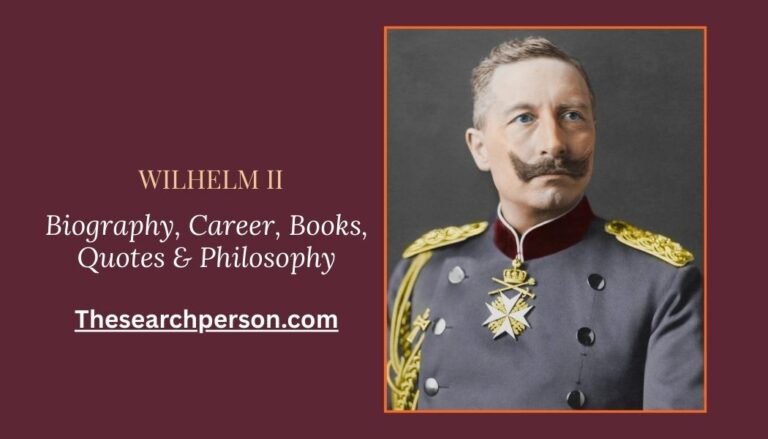
Kaiser Wilhelm II, the last German Emperor and King of Prussia, remains one of the most discussed and controversial figures of early 20th-century European history. His reign marked the final chapter of imperial Germany, his personality shaped the nation’s diplomacy and militarism, and his decisions—often impulsive and dramatic—contributed to the geopolitical tensions that led to World War I.
Early Life & Biography
Wilhelm II Born
Wilhelm II was born on January 27, 1859, in Berlin, Prussia. His full name was Friedrich Wilhelm Viktor Albert. From birth, he stood in line to become the future German Emperor under the newly forming German Empire.
His birth was complicated—he suffered from a traumatic delivery that resulted in a partial paralysis of his left arm, later causing lifelong insecurity. This disability became a defining part of his personality and ambitions.
Wilhelm II Hand – The Birth Injury
Wilhelm’s left arm was noticeably shorter and weaker due to Erb’s palsy. In many photographs, he tried to hide or position the arm to minimize attention. This condition influenced his psychological development and may have contributed to his drive for military glory, dominance, and recognition.
Table of Contents
Family Background
Wilhelm II Father
Wilhelm’s father was Frederick III (Friedrich III), German Emperor and King of Prussia. However, Frederick’s reign lasted only 99 days, as he died of laryngeal cancer shortly after taking the throne in 1888.
Wilhelm II Mother
His mother was Victoria, Princess Royal, the eldest daughter of Queen Victoria of the United Kingdom. This made Wilhelm II a direct member of Queen Victoria’s grandchildren, linking him to major European monarchies.
Queen Victoria Grandchildren Connection
Wilhelm II was one of the most prominent of Queen Victoria’s numerous royal descendants. However, despite this familial tie, he often expressed resentment toward British influence, contributing to Anglo-German tensions.
Education & Early Personality
Wilhelm was educated under a strict Prussian system emphasizing military values, discipline, and nationalism. Although exposed to liberal British influences from his mother, he grew increasingly aligned with conservative Prussian ideals.
He excelled in:
- Military sciences
- History
- Foreign languages
- Political theory
His character traits included:
- Impulsiveness
- Emotional volatility
- Fierce pride
- Desire for respect and authority
These traits greatly impacted his political decisions as Emperor.
Rise to Power
Becoming Kaiser
Wilhelm became German Emperor (Kaiser Wilhelm II) and King of Prussia on June 15, 1888, at the age of 29. His accession marked the beginning of the third emperor of the “Year of the Three Kaisers.”
Break with Otto von Bismarck
One of his earliest—and most consequential—actions was the forced resignation of Chancellor Otto von Bismarck, the architect of German unity.
This represented:
- A shift from cautious diplomacy
- Toward aggressive Weltpolitik (world policy)
- A desire to assert German power globally
Political Ideology & Philosophy
Wilhelm II’s philosophy combined:
- Militarism
- Nationalism
- Monarchical absolutism
- Belief in divine right of kings
- Desire for Germany’s global expansion
He advocated for naval expansion, believing Germany deserved its “place in the sun.” His philosophical worldview contributed directly to rising European tensions.
Kaiser Wilhelm II Role in WW1
How He Influenced the Outbreak of World War I
Wilhelm’s role in World War I is complex and frequently debated by historians, but key points include:
1. Support for Austria-Hungary
He offered Austria-Hungary the infamous “blank check”, promising unconditional support against Serbia after the assassination of Archduke Franz Ferdinand.
2. Militaristic Policies
His naval arms race against Britain worsened relations and created an atmosphere of mistrust among European powers.
3. Aggressive Foreign Policy
Wilhelm often issued provocative statements and pursued confrontational policies, contributing to international crises like:
- The Moroccan Crises
- Naval expansion
- Anti-British rhetoric
4. Loss of Control
Once the war began, real power shifted to German generals—Hindenburg and Ludendorff. Wilhelm became increasingly sidelined and served more as a symbolic figurehead.
The Fall of the Empire & Abdication
Abdication
On November 9, 1918, as Germany faced military defeat and internal revolution, Wilhelm II was forced to abdicate. He fled to the Netherlands, where the government granted him asylum.
This marked the end of:
- The German Empire
- Prussian monarchy
- His political authority
Exile & Final Years
Where Wilhelm II Died
Wilhelm II lived in exile at Huis Doorn, a manor house in the Netherlands, for over two decades until his death.
Wilhelm II Died
He died on June 4, 1941, during World War II, though he played no active role in the conflict. His final years were spent writing memoirs, reflecting on his reign, and defending his legacy.
Personal Life
Wilhelm II Wife
Wilhelm II married Augusta Victoria of Schleswig-Holstein in 1881. She was a devoted wife and played a role in supporting charitable and social welfare programs.
After her death in 1921, Wilhelm married Princess Hermine Reuss of Greiz in 1922.
Wilhelm II Children
From his first marriage, Wilhelm II had seven children:
- Crown Prince Wilhelm
- Prince Eitel Friedrich
- Prince Adalbert
- Prince August Wilhelm
- Prince Oskar
- Prince Joachim
- Princess Viktoria Luise
His second marriage produced no children.
Wilhelm III – The Next Generation
Although there was no German emperor named Wilhelm III, Wilhelm II’s eldest son, Crown Prince Wilhelm, was sometimes informally referred to as a future “Wilhelm III.”
However, the monarchy was abolished before he could assume the throne.
Books Written by Wilhelm II
During exile, Wilhelm authored several works to defend his legacy:
Notable Books
- “The Kaiser’s Memoirs”
- “My Early Life”
- “The Kaiser’s Speeches”
- Collections of essays on politics, monarchy, and Germany’s future
These writings reveal his worldview, regrets, and justifications for his wartime actions.
Famous Wilhelm II Quotes
Some of his most remembered quotes include:
1. Militaristic Quotes
- “I consider myself the instrument of the Almighty.”
- “There is only one master in this country—myself.”
2. On Germany’s Destiny
- “We shall yet be able to win back our place in the sun.”
3. On World War I
- “I did not want this war.”
(A statement disputed by historians.)
4. On Leadership
- “The trident must be in our fist.”
(A reference to naval power.)
These quotes illustrate his beliefs in divine monarchy, nationalism, and military dominance.
Wilhelm II’s Philosophy
Core Philosophical Beliefs
Wilhelm II’s philosophy was shaped by:
- Militaristic Prussian traditions
- Belief in the divine right of kings
- Anti-liberal sentiment
- Strong German nationalism
- Suspicion of democracy
He believed the emperor should wield supreme authority, and his worldview contributed to Germany’s authoritarian political structure before WWI.
Legacy & Historical Assessment
Wilhelm II’s legacy is mixed and controversial.
Positive Aspects
- Modernized German navy
- Expanded industrial capacity
- Promoted scientific and technological innovation
Negative Aspects
- Unpredictable leadership
- Militaristic foreign policy
- Contributed to WWI’s outbreak
- Destroyed relations with Britain
- Oversaw the collapse of German monarchy
Despite his intent to make Germany a major world power, his actions ultimately led to devastation and downfall.
More Info About TheSearchPerson